

🔧 I. Speaker Magnet Materials & Properties
| Magnet Type | Composition | Energy Product | Thermal Stability | Size/Weight | Cost |
|---|---|---|---|---|---|
| AlNiCo | Al, Ni, Co, Fe | Medium | Excellent (Curie >800°C) | Large | High (Co scarcity) |
| Ferrite (Ceramic) | Fe₂O₃ + Ba/Sr compounds | Low | Excellent (Curie >450°C) | Bulky (size compensation) | Low |
| Neodymium (NdFeB) | Nd, Fe, B (Rare Earth) | Very High | Poor (Curie ~310°C) | Compact | Medium-High |
| Field Coil | Copper windings + DC power | Adjustable (No limit) | Good (depends on cooling) | Very Large | Very High |
Key Characteristics:
AlNiCo:
Sound Profile: Warm mids/lows, fast transients (ideal for vocals/strings).
Weakness: Limited high-frequency extension, low power handling (saturates easily).
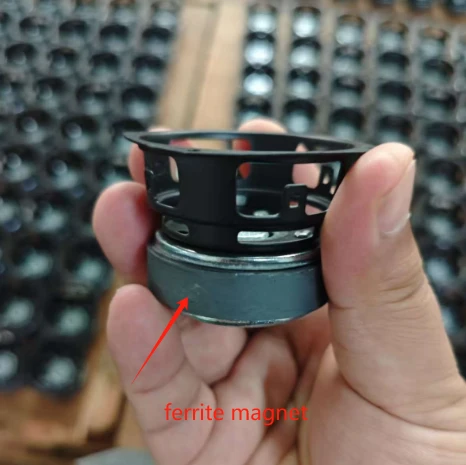
Ferrite:
Sound Profile: Balanced, low distortion but lower sensitivity (requires powerful amps).
Advantage: Cost-effective, heat-resistant (common in home audio/PA systems).
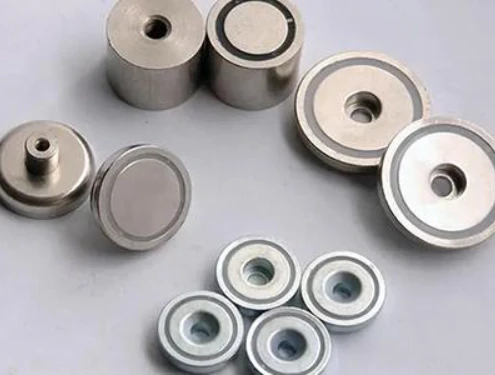
Neodymium (NdFeB):
Sound Profile:
Crystal highs, detailed resolution (ideal for tweeters).
Exceptional transients, precise imaging.
Critical Flaws:
Thermal Demagnetization: >20% flux loss at >80°C → Bass compression.
Oxidation Risk: Requires plating (limits woofer use).
Field Coil:
Sound Profile: Near-zero hysteresis distortion, dynamic authority, black background (Hi-End).
Weakness: External PSU needed, complex/costly (e.g., >$1,000/unit).
🎧 II. Magnet Impact on Sound Quality
Sensitivity & Efficiency:
Higher Flux Density (B) → Better electroacoustic conversion → +dB/W sensitivity.
Example: NdFeB has 10× B of ferrite → +3-6dB SPL at same size.
Frequency Response & Distortion:
Ferrite: Low hysteresis → Clean mids (ideal full-range drivers).
NdFeB: Extended highs, but thermal drift causes bass distortion (>10% FR shift).
Damping Control (Qts):
Higher B → Lower Qts → Tighter bass (improved transients).
NdFeB offers superior bass control at moderate volumes.
Dynamic Compression:
NdFeB thermal demag reduces Bl factor → Nonlinear SPL decay at high volumes ("soft bass").
⚠️ III. Application Guide & Pitfalls
Material Selection:
| Application | Recommended Magnet | Reason |
|---|---|---|
| Tweeters | NdFeB | Minimal heat impact; HF detail advantage |
| Woofers (Home) | Ferrite | Heat-resistant, cost-effective |
| Portable Devices | NdFeB | Compact size, high sensitivity (TWS/headphones) |
| Hi-End Subwoofers | Field Coil | Zero thermal compression, extreme dynamics |
User Misconceptions:
❌ "Bigger magnets = better": Compact NdFeB often outperforms bulky ferrite.
❌ "NdFeB always superior": Ferrite may be more stable in woofers without cooling.
🔬 IV. Advanced Magnet Technologies
Magnetization Process:
Uniform domain alignment improves density/smoothness (reduces harshness).
Example: Beyerdynamic "Tesla Tech" boosts flux efficiency → +30% resolution.
Composite Magnetic Circuits:
Dali SMC (Soft Magnetic Compound): Reduces eddy currents → Cleaner mids.
Dual Shorting Rings: Suppresses midrange distortion in NdFeB (THD↓80%@3kHz).
Thermal Management:
NdFeB woofers require:
Ferrofluid cooling (↑ operating temp to 105°C).
Aluminum heatsinks (e.g., JBL Everest).
💎 Conclusion: Magnet Selection = Balancing Performance & Tonality
Consumers: Ferrite offers value; NdFeB excels in tweeters/portables; avoid uncooled NdFeB woofers.
Audiophiles: Focus on magnetic circuit design (e.g., SMC/shorting rings) - magnetization refinement may outweigh material choice.
Engineers: For NdFeB woofers, test frequency response at 80°C (Klippel recommended).
Magnet materials are foundational but not sole determinants - magnetic circuit design, cooling, and magnetization form an interdependent triad. Only their synergy unlocks pure sound reproduction.