

Classification and Characteristics of Full-Range Speaker Drivers
A full-range driver, also known as a full-range unit, is characterized by its core principle: using a single speaker driver to reproduce as wide a frequency range as possible, which is fundamentally different from multi-way systems that use separate drivers for high, mid, and low frequencies.
Methods of Classification
Full-range drivers are primarily classified based on performance grade and the material of the diaphragm.
1. Classification by Performance Grade
Based on frequency range coverage and distortion levels, they are typically divided into three grades:
| Grade | Typical Frequency Range | Full-Power Distortion | Common Sizes & Applications |
|---|---|---|---|
| Low-End | 150 - 15,000 Hz | > 20% | 2 to 4 inches; used in computers, TVs, multimedia speakers. |
| Mid-Range | 80 - 18,000 Hz | > 5% | 3 to 10 inches; applications with certain sound quality requirements. |
| High-End | 45 - 20,000 Hz | > 2% | 5 to 8 inches; high-fidelity music reproduction, capable of better rendering symphonic music. |
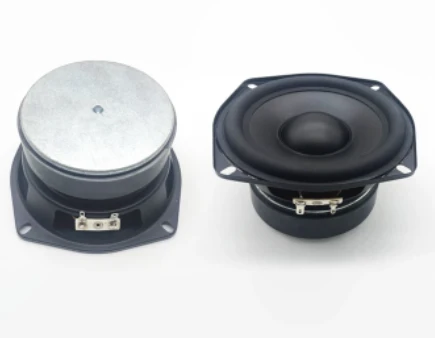
2. Classification by Diaphragm Material
The diaphragm material directly affects the sonic characteristics and is key to determining the timbre of a full-range driver.
Paper Cones: Good internal damping, natural and smooth sound, low cost, but relatively weaker rigidity and limited high-frequency extension.
Plastic Cones: Easy to mold, low cost, but internal damping is usually inferior to paper, making it difficult to achieve high sound quality.
Metal Cones (e.g., aluminum, magnesium): Excellent rigidity and strong high-frequency extension, but low internal damping can lead to harsh resonant peaks if not properly handled. High-end products optimized with damping coatings can achieve extremely wide frequency coverage.
Composite Cones: Such as "sandwich" structures, balancing high rigidity and good damping for excellent performance but at a higher cost.
Core Characteristics & Technical Challenges
Using a single unit to cover the full audio spectrum brings unique advantages and inherent limitations.
Key Advantages:
Precise Phase Response: As a point source, all frequencies emanate from a single point. This avoids phase misalignment and tonal incoherence common in multi-way systems, often resulting in superior soundstage imaging and localization.
Consistent Tonality: The smooth, unified transition across the frequency range without the "cut" of a crossover.
Outstanding Midrange Performance: Energy is typically concentrated in the midrange, where the fundamental tones of vocals and many instruments lie. Therefore, vocals are often reproduced with a full, natural, and engaging quality.
Inherent Limitations & Technical Challenges:
Limited High & Low-Frequency Extension: This is the primary limitation. A single diaphragm struggles to perfectly handle both extremes simultaneously. Large-diameter units favor bass but degrade treble; small units do the opposite.
Distortion at High Output Levels: To pursue wide frequency response and high sensitivity, compromises in diaphragm and voice coil design are necessary, often resulting in a smaller maximum linear excursion (Xmax). This can lead to distortion and "running out of steam" with dynamic musical passages.
Directivity Issues: As frequency increases, sound becomes more directional (beaming), narrowing the optimal listening "sweet spot." This is more pronounced with larger-diameter units.
Comparison with Multi-Way Crossover Systems
For clearer positioning, here's a comparison with mainstream multi-way systems:
| Feature | Full-Range Driver System | Multi-Way Crossover System |
|---|---|---|
| Sound Source Type | Point Source | Multiple Point Sources |
| Phase Coherence | Excellent, naturally coherent | Dependent on precise crossover design and driver alignment |
| Frequency Coverage | Relatively limited, extension at extremes is challenging | Excellent, each driver specializes in its optimal band |
| Tonal Consistency | Excellent, seamless transition across range | Potential for tonal differences between drivers |
| Complexity & Cost | Simple structure, though top-tier units are costly | Complex structure (requires crossover, multiple drivers), high demands on system tuning |
Development Trends
To address traditional limitations, manufacturers continue to innovate:
Structural Innovation: For example, using multi-cone composite diaphragms where the main cone handles bass, and concentrically mounted cones of different sizes manage midrange and treble to extend bandwidth.
Hybrid Designs: While retaining the full-range driver as the main mid/high unit, adding a dedicated woofer to form a "1.5-way" or "2-way" system, thereby compensating for lack of deep bass and dynamic impact.
In summary, the appeal of full-range drivers lies in their simple and accurate approach to sound reproduction, making them particularly suitable for listening scenarios that prioritize midrange richness, vocal performance, and precise soundstage imaging. When choosing, you must balance high-frequency extension, low-frequency reach, and dynamic capability according to your listening preferences.
If you would like more specific analysis on selecting full-range drivers for particular applications (such as desktop Hi-Fi or car audio), I can provide further details.